The 1 Rep Max Calculator is a quick and easy tool that estimates how much weight you can lift for a single repetition. By entering the weight you used and the number of reps you completed, you get a reliable estimate of your true strength level. This helps you set training goals, choose proper weight ranges, and track your progress over time, whether you’re a beginner or an experienced lifter.
What is 1 Rep Max (1RM)?
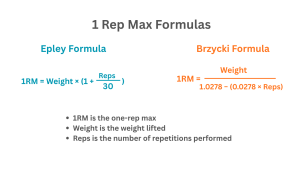
When training, 1 repetition max, or often known as 1 rep max, is the most weight someone can lift in a single repetition. Another way to think about it is as the maximum force that can be produced in a single maximal contraction. In sports like powerlifting and weightlifting, the winner can be determined by the 1-rep max, which can be used to determine someone’s maximal strength. Another usage can be for the maximum limit to figure out the ideal weight for a workout. Below you will have the formulas that are used in our calculator, that also you can use to do manual calculation.
Importance of one rep max?
The primary part is that it serves as a guide for finding out the right weight to use based on objectives such as muscle growth, strength, or stamina, etc. It’s useful for customizing your exercise routine to optimize it for the desired results. Fitness coaches usually advise you to perform 8-10 repetitions, with weights that are in the range from 65% to 85% of the 1-rep maximum. The purpose of this suggestion is to help you grow muscles through training. On the other hand, if you don’t know your 1RM, the advice isn’t helpful, and this is why we have created the One Rep Max Calculator.
How 1RM Guides Your Training?
You might use it for figuring out the right intensity of training for different exercises. By doing this you make sure that you are exercising with the appropriate load to achieve the desired objectives . It effects the number of repetitions and sets you will perform as percent of your 1rm. Desired objectives, skills level and the specific workout and activity will determine how much weight you should lift and how many repetitions and sets you will perform.
Why to Use a 1RM Calculator?
Three of the main reason to use 1 RM calculator are:
- Avoids the risk of injury from testing max effort directly
- Helps in designing workout plans
- Useful for tracking progress in strength training
Based on the output of the 1 rep max calculator, depending on your fitness level and goal, below are the suggestions for some of the workouts you can do and maybe get the results you want:
- For muscle growth: 65–85% of 1RM, 8–12 reps
- For strength: 85–95% of 1RM, 3–6 reps
- For endurance: 50–65% of 1RM, 12+ reps
Frequently Asked Questions (FAQs)
1. What is the purpose of knowing my 1RM?
Your 1RM shows the maximum weight you can lift for one repetition. It helps you track your strength and plan your workouts. Different percentages of your 1RM are used for goals like building muscle, endurance, or strength.2. Does testing my 1RM build muscle?
Testing your 1RM mostly measures strength, not muscle size. But knowing your 1RM helps you lift heavier weights for your regular workouts, which can build muscle over time. For muscle growth, train with about 70–85% of your 1RM for 6–12 reps.3. How often should I test my 1RM?
You shouldn’t test your 1RM too often. For most people, testing every 4–6 weeks is enough. Competitive lifters might test 2–4 times a year.4. Is it safe for beginners to test their 1RM?
Beginners should avoid testing a true 1RM. Instead, use an estimated 1RM calculator, which is safer and still gives useful numbers. Focus first on learning proper lifting form.5. Can I use a 1RM calculator to guide my training?
Yes! An estimated 1RM helps plan workouts and track progress without the risk of lifting your absolute maximum all the time. Most training plans use percentages of your 1RM.6. Are 1RM calculators accurate?
They give a good estimate but aren’t perfect. They work best when the number of reps used in the calculation is low. For example, a 3-rep max gives a more accurate estimate than a 10-rep max.7. How does a 1RM calculator work?
The calculator uses formulas like the Epley formula (1RM = Weight × (1 + Reps ÷ 30)) to estimate your max lift. You enter the weight you lifted and how many reps you did, and it calculates your estimated 1RM.8. Can I use the calculator for any exercise?
Yes, it works for most exercises like squats, bench presses, and deadlifts. It’s most accurate for big, compound movements. Isolated exercises or bodyweight moves are less precise.9. What are common mistakes when testing a 1RM?
- Poor form: Lifting incorrectly can cause injury and give a false result.
- Not enough rest: You need 3–5 minutes between attempts to avoid fatigue.
- Too many attempts: Lifting too many heavy singles in one session wears out your nervous system.
- Testing multiple lifts in one day: Doing squats, bench, and deadlifts all on the same day can affect results.
10. How should I prepare the day before a 1RM test?
Rest well the day before. Sleep enough and eat properly so your muscles are ready. Avoid heavy workouts the day before testing.Explore More of Our Tools
Discover additional calculators that can help you with a variety of everyday tasks and calculations. These calculators are designed to help you solve a wide range of everyday problems quickly and accurately. Our site offers a variety of helpful calculators designed to make your life easier. Click on any of the tools below to explore related calculators and discover more ways to quickly perform everyday calculations.
Mass Unit Converter →
Quickly convert between common mass units like grams, kilograms, pounds, and ounces with just one input.
Weeks From Today Calculator →
Find out the exact date that falls a specific number of weeks from today in just one step.