Our discount calculator helps you quickly figure out how much money you can save during a sale and what the final price will be after the discount is applied. Instead of calculating percentages manually, this tool gives you instant and accurate results by simply entering the original price and the discount percentage. It’s useful for shoppers who want to compare deals and make smarter purchase decisions, as well as for businesses that need to confirm their promotional pricing. With clear results showing both the savings and the updated price, discount calculator makes the whole process faster, easier, and error-free.
Discount Calculator
What is discount?
To describe discount is simple words is the reduction of the initial price of a item, product or service. Businesses commonly apply it to attract customers, increase sales, or get rid of outdated products because it reduces what the customer spends. The two common ways that discounts are expressed are by fixed prices like 10$ off, and by percentage such 30% off. Also, discounts come in different forms such as trade discounts for retailers, promotional sales, bulk/quantity reductions, and loyalty benefits for loyal customers. Discounts helps customers to save money, but it’s important to think about if the purchase is actually necessary.
Why Discounts Matter in Everyday Life?
Discount have significant importance for both psychological as well as practical reasons. In the financial part they assist in smarter and better planning, by helping businesses in increasing sales, gain clients, and move inventory, and it expands the budget so they can get more products and services, which also increases them. On the psychological part, discounts offer to costumers a feeling of satisfaction or success of finding a good deal, lowers stress by convincing them that the money is well spent, push them to spent more, and by giving them a limited-time deal it gives the feeling to hurry and move fast from time limit. Beside being a reduced price, the discount have an impact on customers behavior and well being.
The Problem With Manual Discount Calculations
For Costumers:
- Manual discount calculation can raise the possibility of being overcharged due to basic human mistakes, which also result in damaging the trust toward the business.
- Staff members may take more time in calculating manually the final price, which results in slower checkout.
- When the calculation is done manually for complex discounts is more difficult for customers to fully understand , leading to confusion over the final price.
- Customers may feel treated different in comparison to others if discounts are applied in differently.
- If the discount are managed in bad or poorly way it reduces the perceived value of product or service , making the purchasing experience less pleasant.
For Business:
- Pricing errors caused by manual discount calculation might result in reduced profits and cause financial problems.
- Spreadsheets and approvals take up important team time, which slows down operations and delays sales.
- Mangers consider it a challenge to identify problem or quickly modify tactics when they have lack or no real-time data visibility of the discount performance.
- When discount mistakes increase, revenue forecasting becomes unreliable, which results in making long-term planning more difficult.
- Manual methods eventually fail as discount structures become more complicated.
Why Accurate Discount Calculations Matter
Accurate discount calculations are crucial, since allow costumers and companies to make wise financial decisions. Having accurate discount ensure that costumers pay a fair price and don’t get overcharged. They help companies to maintain costumers confidence, maintain profit margin, and enable smart inventory clearance. Proper discounting helps businesses and investors to accurately estimate future cash flows and keep way from risky or bad investment decisions. Doing a correct calculation of discount ensures equity, and supports better financial planning at all levels.
Types of Discounts Consumers Commonly Encounter
- Percentage discounts, like 20% off
- Fixed-amount discounts, like $10 off
- Buy One Get One (BOGO) deals.
- Tiered discounts, like “Spend $100 get $20 off”.
- Seasonal/promotional discounts, such as Black Friday, holiday sales, etc.
- Loyalty or student discounts.
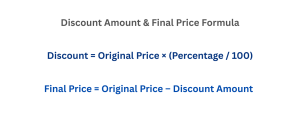
Understanding the Math Behind Discounts
What Is a Discount Calculator?
Discount calculator is a simple tools that helps to quickly calculate the final price after discount applied and see how much you save. You simply just enter the original price and the discount (percentage or fixed amount) of the product, and it shows you the discounted price and how much money you save. It’s a useful tool for comparing deals quickly, having a understanding if the discount is good, and making smarter shopping decisions. Discount percent off calculator is a simple way of avoiding manual mistakes and shopping smartly.
Why Use a Discount Calculator?
The primary use cases of percentage off calculator are to save time, having accurate totals, and lowering the chances for calculations mistakes. It helps costumers in making better purchases and knowing how much they are saving by displaying the final price and the amount of money saved. On the other hand , it supports business in monitoring sales, determining the promotional prices, and ensuring profibility. It males the comparing process of different discounts much simpler by displaying in proper way which offer gives the best value. A discount calculator gives every price choice clarity and assurance, whether you’re shopping or running a business.
Common Use Cases of Discount Calculator?
As we have described the discount percent off calculator is a simple tools that companies and customers can use for a variety of financial situations. Its main purpose is to quickly determine the final prices, savings, or initial expenses connected to price reductions. Below you will have the common use cases of it for both business and customers.For Customers:
- Quickly calculate the final price and total savings during sales or promotions.
- Compare different deals to find the best value.
- Apply coupons or multiple discounts to see the true final cost.
- Plan budgets better by knowing the exact amount they will spend.
- Use accurate price estimates to negotiate or confirm fair pricing.
For business:
- Set promotional prices while protecting profit margins.
- Create effective discount campaigns like seasonal offers or BOGO deals.
- Move old or slow inventory more efficiently with targeted discounts.
- Forecast sales and revenue more accurately using precise discount values.
- Calculate and track discount amounts for financial reporting and internal analysis.
Benefits of Using a Discount Calculator
- Accuracy when calculating multiple discount layers.
- Helps customers make informed decisions.
- Reduces overspending by showing true final cost.
- Businesses can set consistent pricing across promotions.
Example of a Percentage Discount
Here you will find how to calculate discount manually, next you will have the example and step-by-step calculations.
Example: A jacket originally costs $120 and the store is offering 35% off.Step 1: Calculate the discount t amount:
35% of 120 = 0.35 × 120 = $42
Step 2: Subtract the discount from the original price:
120 − 42 = $78
Final price: $78
Total saved: $42
Tips for Getting the Best Discount
To get the best deals and maximize savings, plan ahead, make some research, and take advantages of in-store and online alternatives. To strategically have good purchases keep an eye out for special specials and seasonal sales. To be sure you are receiving the best possible price, compare prices from several retailers or websites. You may prevent overspending and make better choices in purchasing by following some of the below tips.
- Research competitor prices to know a reasonable deal.
- Look for special discount days, like customer appreciation or senior discount days.
- Search for discount codes or coupons before checkout.
- Check for “new customer” promotions.
- Sign up for newsletters and loyalty programs for exclusive offers.
- Watch for “free gifts with purchase” that add value.
- Don’t rush: avoid impulse buys and wait for the best price.
Frequently Asked Questions (FAQs)
1. What is the difference between “list price” and “selling price”?
The list price is the original price before any discounts. The selling price is the final price you pay after discounts are applied.
2. How do I handle multiple discounts?
They must be applied one at a time. Each discount applies to the already-reduced price, not the original price.
3. Should I use a percentage or fixed-amount discount?
Percentage discounts are better for expensive items. Fixed-amount discounts are more useful for low-cost items.
4. Why do businesses offer discounts?
To attract customers, increase sales, clear out old inventory, introduce new products, and reward loyal shoppers.
5. Are discounts always a good deal?
Not always. Make sure the product is worth buying and compare prices before assuming the discount is good.
6. What is the difference between a discount and a rebate?
A discount reduces the price immediately. A rebate returns money to you after the purchase.
7. Can I use the calculator to find the original price?
Yes. Use: Original Price = Final Price ÷ (1 − Discount Rate).
8. How do I calculate a fixed-amount discount?
Just subtract it from the original price. Example: $95 − $20 = $75.
9. What input formats does the calculator accept?
Our discount percentage calculator accept standard numbers for original price and discount rate (e.g., “50” and “15”).
10. Can I use this for calculating employee discounts?
Yes, you simply input the product original price and the specific employee discount percentage (like 20% or 30%) to quickly determine the exact amount the employee owes.
Explore More of Our Tools
Discover additional calculators that can help you with a variety of everyday tasks and calculations. These calculators are designed to help you solve a wide range of everyday problems quickly and accurately. Our site offers a variety of helpful calculators designed to make your life easier. Click on any of the tools below to explore related calculators and discover more ways to quickly perform everyday calculations.
Markup Calculator →
Quickly determine selling prices and profit margins based on your cost and desired markup.
Split Bill Calculator →
Easily divide expenses among friends and calculate how much each person owes.
Chronological Age Calculator →
Instantly find your exact age in years, months, and days.