The Factorial Calculator quickly computes the factorial of any non-negative integer. Simply enter a number, and it will calculate the product of all positive integers up to that number. This tool is perfect for math students, programmers, or anyone working with factorials.
What is Factorial ?
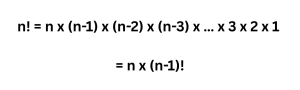
The results of multiplying any natural number with all the numbers that are less than it is defined as factorials. The factorial method is commonly used for problems that you have to find the possible number of orders for a given set of items. Exclamation mark is how factorial is represented . like this is how factorial is written n! . An important note related to the topic is that negative numbers don’t have factorials and the reason is because negative numbers can’t be arranged.The factorial formula is
For what is used factorial ?
To estimate the number of possible combinations for an item is factorial, so every item in a factorial serves a purpose and cant be used more than once. Along with it uses in fields like probability, algebra, number theory, compute science and more, factorials are used in mathematics for power series related to exponential function and other functions in mathematical analysis.How to Calculate a Factorial Manually ?
Step by step guide how to do the calculation of the factorial :- Step 1: Identify the value of the factorial n.
- Step 2: For n!, write the sequence.
- Step 3: Multiply the sequence’s values.
Who It’s For and How is Used our Calculator?
The calculator is good to be used because when dealing with large numbers doing the calculation manually you may end up with errors. Suppose you have to find the factorial of 10 that is equal to 3628800, finding the answers cant be time consuming but errors can be done. If you have to deal with larger numbers finding the right answer it will be time consuming and making errors, so not dealing with this problems our calculator is on your service.Our Factorial Calculator is ideal for :
- Math students learning factorials and combinations.
- Teachers and educators preparing lessons or assignments.
- Statisticians, researchers, and software developers using factorial functions in formulas.
How to Use the Calculator:
- Enter a non-negative integer.
- Press the “Calculate button.
- Instantly get the factorial value.
Frequently Asked Questions (FAQs)
1. Why is 0! equal to 1?
By definition, 0! is 1, by definition is consistent with the recursive definition of factorials. This works with the normal factorial rules and makes sense in counting, there’s exactly one way to arrange nothing, which is the “empty” arrangement.2. Can I calculate the factorial of a negative number?
No, factorials are only for zero and positive numbers. Negative numbers don’t have a factorial.3. Can factorials be calculated for decimals or fractions?
The usual factorial only works for whole numbers. But there’s a special math function called the Gamma function that extends factorials to decimals and other numbers.4. Where are factorials used in real life or math?
Factorials appear in many areas:- Combinatorics: Counting arrangements and orders
- Probability & Statistics: Figuring out chances and combinations
- Calculus: In series and equations
- Computer Science: In coding and algorithms
5. Are factorials always even numbers?
Yes, for any number bigger than 1, the factorial will always be even because it includes 2 as a factor.6. How big is 100!?
The factorial of 100 has 158 digits. Its approximate value is about 9.33 × 10157.7. How can factorials help in real-world situations?
Factorials help in planning and organizing, like:- Finding all possible routes for delivery trucks
- Calculating different ways to schedule tasks
- Figuring out all possible arrangements in games or events
Explore More of Our Tools
Discover additional calculators that can help you with a variety of everyday tasks and calculations. These calculators are designed to help you solve a wide range of everyday problems quickly and accurately. Our site offers a variety of helpful calculators designed to make your life easier like the Factorial Calculator. Click on any of the tools below to explore related calculators and discover more ways to quickly perform everyday calculations.
Permutation with Replacement Calculator →
Quickly calculates the number of arrangements when items can be repeated.
Combinations Calculator (nCr) →
Finds how many ways you can choose a subset of items without caring about the order.
Permutations Calculator (nPr) →
Calculates the number of ways to arrange items when the order matters.