This page provides helpful explanations, examples, and Fraction Calculator tools to assist you in solving problems quickly and accurately. Understanding fractions is a fundamental part of mathematics, whether you’re working on homework, handling measurements in daily life, or solving more advanced problems. Fractions represent parts of a whole, and learning how to add, subtract, multiply, divide, or convert them into decimals and percentages can make many tasks much easier.
Fraction Calculator ⭣
Note: The numerator and denominator cant be 0 due to mathematical rules.
Decimal to fraction Calculator ⭣
Fraction To Decimal Calculator ⭣
Percent To Fraction Calculator ⭣
Fraction To Percent Calculator ⭣
Introduction to Fractions
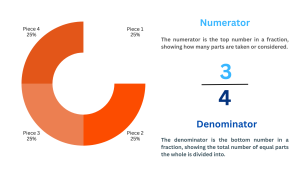
When we order a pizza it comes as whole in a box and when we open the box is divided into parts. By this, we understand that fractions represent the whole of an object that is separated into equal parts, and they can be represented like more then 0 but less than 1 . Also, from this, we come to another part of the fractions that are the components of a fraction which are the numerator and denominator. The numerator is the equal parts of the pizza and the denominator is the number that the pizza is divided as a whole.
Example of fraction
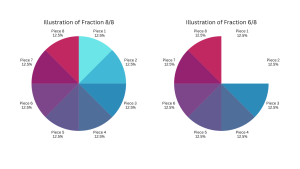
So, we take the example of the pizza and explain it for a better understanding. Usually, a pizza comes divided into 8 pieces so we have a whole number that is divided into 8 pieces. When we get one slice from the pizza and put it onto a plate the plate becomes a fraction that is equal to 1/8 and the remaining slice on the box becomes a fraction of 7/8. Numbers 1 and 7 are the numerators and 8 is a denominator. In the illustration below, you’ll see a full circle represented as 8/8. Next to it, we show a circle with 2 pieces missing, which means 6 out of 8 slices are left, written as 6/8, these is good to know before using our fraction calculator.
Components of a Fraction
Fractions as we have talked a little before has 3 main components that are numerator, denominator and the fraction bar. For each part having an understanding is crucial for analyzing, interpreting, computing and visualizing them. To make it simpler to understand below you have an image describing each components of the fractions.
Types of Fractions
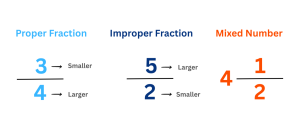
There are several ways to categorize fractions like proper, improper or mixed fractions. Improper fractions have a numerator that can be equal or higher than the denominator, indicating 1 or more. While proper fractions have a numerator that is smaller than the denominator are less then 1. Mixed number fractions are a combination of a whole number and a correct fraction. Also, there other types of group fractions that are like fractions ( have the same denominator), unlike fractions that have different denominators, and equivalent fractions that have the same value but they are different ( e.g, 1/2 = 2/4).
Why Fraction Calculations Matter
Being able to calculate fractions is crucial for both daily life and academic success. They are mainly used for measuring portions, computing discounts managing your budget, and adding more accuracy in areas of cooking, shopping, banking, time management, construction and healthcare. Fractions also hare a foundation for advanced mathematical concepts such division, algebra, ratios, etc. Gaining knowledge with fractions boosts your confidence while working with numbers and doing precise calculations in many different real-world sutiations.
Fractions as Percentages and Decimals
A fraction can be represented as a percentage of a whole number or in decimal numbers. In the percentage part, 1/8 is equal to 12.5% and 7/8 is equal to 87.5% of the whole pizza. For the decimal numbers, part 1/8 is represented as 0.125, and 7/8 is represented as 0.875. Fractions, decimals, and percentages provide different ways of describing pieces of a total that are helpful in daily life for science, cooking, shopping, finance, and other things.
Decimals offer accuracy, percentages helps with comparison, and fractions illustrate parts. Having the ability to convert them manually or by the help of the calculator, assists you in calculations, budgeting, measures, and understanding statistics. Having the right understanding and knowledge of these concepts assists you in more complex math skills and increases problem-solving.
Common mistakes and tips for fractions
Sometimes fractions may be challenging, and when doing some calculations, students tend to make some typical mistakes. Building a solid foundation and avoiding misunderstanding may be achieved by being aware of these faults and following to important advice.
Mistakes
- Adding numerators and denominators directly (e.g., 1/2 + 1/3 ≠ 2/5)
- Forgetting to find a common denominator for addition/subtraction
- Confusing rules for division, applying add/subtract instead of invert-and-multiply
- Misinterpreting the denominator (e.g., thinking 1/4 is larger than 1/2 because 4 > 2)
- Simplifying parts of a problem before completing the operation
Tips
- Visualize fractions with drawings, number lines, or models
- Always find the least common multiple for addition/subtraction
- Use “invert and multiply” for division (Keep, Change, Flip)
- Understand the meaning of numerator and denominator
- Simplify your answer only after completing all calculations
- Recognize that the fraction bar represents division
Our Fraction calculators
Before you came to our site you needed some information or calculations related with fractions, and in these page you will find some information you need for fractions and calculators. To make your life easier we have created a calculator to convert or calculate fractions into percentages, decimal numbers or doing some computations like adding, subtracting, etc .Fraction Calculators are tools designed to help you quickly solve fraction problems without doing manual calculations.
These fraction calculators are created to be user friendly, they only need to input the values they need to each of them and click the button to get the results you need. Also, in the final results is showed the step-by-step calculations for each of them. Below you will have each of them explained what they do.
Fraction Calculator
The fraction calculator is a tool that does mathematical operations including 2 fractions, and based on your need it adds, subtracts, divides or multiplies them. It is designed to simplify these computations and provide you with accurate results.
Decimal to fraction Calculator
The decimal to fraction calculator is a tool that helps you easily convert decimal number into a exact fraction form like 0.75 = ¾. These tool is useful in math, construction, cooking and more, for precise measurements.
Fraction To Decimal Calculator
The fraction to decimal calculator is the vice versa of the decimal to fraction calcualtor it converts the fractions into their equivalent decimal from like ¼ = 0.25, by dividing the numerator and the denominator. It’s a helpful tool for students, professionals, science, finance, when they need quick and accurate conversions.
Percent To Fraction Calculator
The percent to fraction calculator is a tools that helps in converting percentage into its simplest fraction like 75% = ¾ . It helps to understand proportions and realtionships between parts and wholes.
Fraction To Percent Calculator
The fraction to percent calculator is also the the vice versa or percent to fraction calculator, it converts the fractions into their equivalent percentage by dividing the numerator with denominator and then multiplying by 100.
Frequently Asked Questions (FAQs)
1. Does the calculator simplify fractions automatically?
Yes,our online fraction calculator will automatically reduce fractions to their simplest form by dividing both the numerator and denominator by their greatest common factor (GCF).
2. What is the “least common denominator” (LCD)?
The least common denominator is the smallest multiple that is shared by the denominators of two or more fractions. It’s necessary when adding, subtracting, or comparing fractions with different denominators.
3. What does the line in a fraction mean?
The line separating the numerator and denominator is called a vinculum. It shows division, meaning the top number is divided by the bottom number (e.g., 3/4 equals 3 divided by 4).
4. How do you convert a mixed number to an improper fraction?
To convert a mixed number, multiply the whole number by the denominator, add the numerator, and place the result over the original denominator. For example, 2 1/4 becomes (2 × 4 + 1)/4 = 9/4.
5. Can I calculate a percentage from a fraction using this calculator?
Yes, our Percent To Fraction Calculator or Fraction To Percent Calculator allow you to convert fractions to percentages or vice-versa. Simply enter your fraction or percentage and the calculators will show the result.
6. Can a fraction have zero in the denominator?
No, a fraction cannot have zero as the denominator. Division by zero is undefined, so any fraction with a zero denominator is invalid.
7. Can fractions be larger than 100%?
Absolutely. Improper fractions, where the numerator is bigger than the denominator (like 3/2), represent more than one whole. When converted to a percentage, 3/2 equals 150%.
8. How do you simplify a fraction?
To simplify a fraction, divide both the numerator and the denominator by their greatest common factor until no further reduction is possible.
9. How are fractions, decimals, and percentages related?
Fractions, decimals, and percentages all represent the same value in different forms. Divide the numerator by the denominator to get a decimal, and multiply that decimal by 100 to convert it to a percentage.
10. How do you compare two fractions with the same denominator?
When fractions share the same denominator, the fraction with the larger numerator is the bigger fraction.
Explore More of Our Tools
Discover additional calculators that can help you with a variety of everyday tasks and calculations. These calculators are designed to help you solve a wide range of everyday problems quickly and accurately. Our site offers a variety of helpful calculators designed to make your life easier. Click on any of the tools below to explore related calculators and discover more ways to quickly perform everyday calculations.
Markup Calculator →
Quickly calculate markup percentages, selling prices, or profit based on cost.
Factorial Calculator →
Instantly compute factorial values for any non-negative integer.
Discount Calculato →
Easily find the final price after applying discounts, including percentage-off savings.