The Mass Unit Converter is a practical and user-friendly tool for quickly converting between major units like grams, kilograms, pounds, ounces, and more. Our mass converter follows the internationally recognized SI standards to ensure accurate and reliable results. Whether for educational, professional, or personal use, it simplifies mass measurement and reduces conversion errors.
Common Mass Conversions
Below is a list of common mass conversion to help you quickly compare different weight units that are frequently used in daily life. You’ll find examples such as 130 lbs to kg, 25 mg to g, 5 oz to g, and several other widely used conversions.
Kg To Lbs
- 20 kg to lbs → 44.1 lbs
- 40 kg to lbs → 88.185 lbs
- 45 kg to lbs → 99.208 lbs
- 50 kg to lbs → 110.231 lbs
- 55 kg to lbs → 121.254 lbs
- 60 kg to lbs → 132.277 lbs
- 65 kg to lbs → 143.3 lbs
- 67 kg to lbs → 147.71 lbs
- 70 kg to lbs → 154.324 lbs
- 80 kg to lbs → 176.37 lbs
- 90 kg to lbs → 198.416 lbs
- 100 kg to lbs → 220.462 lbs
- 120 kg to lbs → 264.55 lbs
- 160 kg to lbs → 352.74lbs
- 180 kg to lbs → 369.832 lbs
Lbs to Kg
- 120 lbs to kg → 54.431 kg
- 125 lbs to kg → 56.699 kg
- 130 lbs to kg → 58.967 kg
- 135 lbs to kg → 61.235 kg
- 140 lbs to kg → 63.503 kg
- 145 lbs to kg → 65.771 kg
- 150 lbs to kg → 68.039 kg
- 155 lbs to kg → 70.307 kg
- 160 lbs to kg → 72.575 kg
- 165 lbs to kg → 74.843 kg
- 170 lbs to kg → 77.110 kg
- 175 lbs to kg → 79.379 kg
- 180 lbs to kg → 81.647 kg
- 185 lbs to kg → 83.915 kg
- 190 lbs to kg → 86.183 kg
- 195 lbs to kg → 88.450 kg
- 200 lbs to kg → 90.718 kg
Mg to G
- 10 mg to g → 0.01 g
- 25 mg to g → 0.025 g
- 50 mg to g → 0.05 g
- 100 mg to g → 0.1 g
- 200 mg to g → 0.2 g
- 300 mg to g → 0.3 g
- 400 mg to g → 0.4 g
- 500 mg to g → 0.5 g
- 1000 mg to g → 1 g
- 1500 mg to g → 1.5 g
- 2000 mg to g → 2 g
- 5000 mg to g → 5 g
G to mg
- 0.1 g to mg → 100 mg
- 0.2 g to mg → 200 mg
- 0.25 g to mg → 250 mg
- 0.5 g to mg → 500 mg
- 1.5 g to mg → 1,500 mg
- 2 g to mg → 2,000 mg
- 5 g to mg → 5,000 mg
- 10 g to mg → 10,000 mg
- 25 g to mg → 25,000 mg
- 100 g to mg → 100,000 mg
G to Kg
- 1 g to kg → 0.001 kg
- 2 g to kg → 0.002 kg
- 10 g to kg → 0.01 kg
- 50 g to kg → 0.05 kg
- 100 g to kg → 0.1 kg
- 198 g to kg → 0.198 kg
- 200 g to kg → 0.2 kg
- 250 g to kg → 0.25 kg
- 500 g to kg → 0.5 kg
- 1000 g to kg → 1 kg
Kg To G
- 0.5 kg to g → 500 g
- 1 kg to g → 1000 g
- 1.5 kg to g → 1500 g
- 2 kg to g → 2000 g
- 2.5 kg to g → 2500 g
- 3 kg to g → 3000 g
- 5 kg to g → 5000 g
- 5.6 kg to g → 5600 g
- 10 kg to g → 10,000 g
- 1000 kg to g → 1,000,000 g
Oz to G
- 1 oz to g → 28.35 g
- 2 oz to g → 56.7 g
- 3 oz to g → 85.05 g
- 4 oz to g → 113.4 g
- 5 oz to g → 141.748 g
- 6 oz to g → 170.097 g
- 7 oz to g → 198.45 g
- 8 oz to g → 226.796 g
- 9 oz to g → 255.146 g
- 10 oz to g → 283.495 g
- 12 oz to g → 340.194 g
- 14 oz to g → 396.893 g
- 16 oz to g → 453.592 g
- 18 oz to g → 510.291 g
- 24 oz to g → 680.389 g
- 28 oz to g → 793.787 g
- 32 oz to g → 907.185 g
Oz to Lbs
- 1 oz to lbs → 0.0625 lbs
- 2 oz to lbs → 0.125 lbs
- 4 oz to lbs → 0.25 lbs
- 8 oz to lbs → 0.5 lbs
- 10 oz to lbs → 0.625 lbs
- 12 oz to lbs → 0.75 lbs
- 16 oz to lbs → 1 lbs
- 20 oz to lbs → 1.25 lbs
- 24 oz to lbs → 1.5 lbs
- 26 oz to lbs → 1.625 lbs
- 28 oz to lbs → 1.75 lbs
- 32 oz to lbs → 2 lbs
- 36 oz to lbs → 2.25 lbs
- 40 oz to lbs → 2.5 lbs
- 48 oz to lbs → 3 lbs
- 72 oz to lbs → 4.4375 lbs
What is mass?
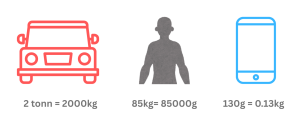
The definition of mass, in simple words, is the amount of matter that makes up an item. The atomic and molecular structure of something defines its mass. Protons, neutrons, and electrons are the building blocks of all objects. All this objects have a variety of weights and form. Mass stays constant and doesn’t change with the position it may be in comparison with weight that due to gravity force it changes.
Metric vs. Imperial Mass Units
The mass Imperial system, which is commonly used in the US, UK, Liberia, etc., is the measuring system that includes units like pound, ounce, etc. The conversion units in the Imperial system don’t follow any particular pattern , like in 1 pound is 16 ounces or in 1 stone is 14 pounds. On the other hand, the Metric system is defined as a decimal unit with base 10. Units that are part of the metric system are grams, kilograms, etc. An example of a mass Metric unit is 1 kilogram, which is equal to 1000 grams. Both the metric and imperial mass units are included on our Mass Unit Converter.
What It Does, Who It’s For, and why the Mass Unit Converter is important?
Mass unit conversion is essential for maintaining the measurement precision and avoiding mistakes. When we want to measure a heavy machine that may weigh around 28,000 kilograms but we would instead convert it to tonne. The reason of the conversion can be due to large numbers and also different countries use different units and for some people can be confusing for both satiation can be a little confusing. So, the purpose of the mass unit converter is to avoid mistakes and confusion when working across systems.
How to Use Mass Unit Converter:
- Enter the value of the mass.
- Select the unit you’re converting from.
- Select the unit you’re converting to.
- Click “Convert” to get an instant result.
The Mass Unit Converter is ideal for:
- Students and teachers in science and math.
- When cooking, converting quantities across unit systems.
- Fitness professionals and dieticians measure body mass or food weight.
Frequently Asked Questions (FAQs) for Mass Unit Converter
1. Is there a difference between mass and weight?
Yes. Mass is the amount of matter in something, while weight is the force of gravity acting on that mass. In everyday life on Earth, people use the terms the same way because the numbers are very similar.
2. What is the main unit of mass in the metric system?
The main SI unit of mass is the kilogram (kg). For smaller everyday measurements, people often use grams (g).
3. How do I convert between big and small mass units?
Is a very simple rule for a larg unit to smaller one just multiply, when converting from a small unit to large one devide.
4. What mistakes do people commonly make when converting mass?
People often tend to mix up conversion factors, forget to check the unit they need to convert, and multiply when they should devide or the opposite.
5. How do I convert between metric and imperial units, like pounds and kilograms?
To converter them you need the specific conversion factors. An example is conver 1 pound to kg is 0.4536, and 1 kg to pound is 2.2 lbs. In simple word lbs to kg we devide and kg to lbs we multiply.
6. What’s the difference between a ton and a tonne?
A tonne (also called a metric ton) is used in most countries and is equal to 1,000 kilograms.A US ton (short ton) is smaller and equals 2,000 pounds, and UK ton (long ton) is a bit bigger and equals 2,240 pounds.
Explore More of Our Tools
Discover additional calculators that can help you with a variety of everyday tasks and calculations. These calculators are designed to help you solve a wide range of everyday problems quickly and accurately. Our site offers a variety of helpful calculators designed to make your life easier. Click on any of the tools below to explore related calculators and discover more ways to quickly perform everyday calculations.
Volume Units Converter →
>Convert form different volume units like liter, gallon, meter cube, and more.
Area Units Calculator →
Convert form different area units like hectare, acre, meter square, and more.
Length Units Converter →
Converts between meters, kilometers, miles, foot, and other common length units.